
If you run a dental practice, you already know the truth behind most missed appointments and delayed treatment. Patients do not fall off because your team does not care. They fall off because life gets busy, follow up becomes manual, phones get overloaded, and visibility is limited.
That breakdown creates two problems at the same time.
First, patients delay care. What starts as a small issue can become more complex, more uncomfortable, and more costly down the road.
Second, your team spends hours chasing patients instead of focusing on the patients who are in front of them. Schedules become harder to manage, last minute openings become harder to fill, and treatment acceptance suffers.
High performing practices do things differently. They do not treat recall and treatment plan follow up as separate projects. They treat them as one connected follow up system with clear ownership, consistent timing, and low friction scheduling.
Below is a practical playbook you can start using immediately.
What a strong follow up system actually does
A best practice follow up program is not just reminders. It is a system designed to do four things consistently.
- Keep patients from falling through the cracks
Patients should always have a clear next step, whether they are due for hygiene, overdue, or leaving with unscheduled treatment. - Reduce friction to schedule
If a patient has to call, wait, and coordinate schedules during business hours, follow up will fail more often than it succeeds. Convenience drives compliance. - Create reliability for your team
When follow up is system driven, your team is no longer relying on memory, sticky notes, or heroic effort. - Protect the schedule and continuity of care
The goal is not just to fill today. It is to keep patients consistently moving forward with preventive care and recommended treatment.
Why recall and treatment follow up belong together
Practices often treat these as separate problems.
Recall is seen as hygiene retention.
Treatment follow up is seen as case acceptance.
In reality, they are two points on the same care journey.
A patient who delays recall is more likely to return with more advanced needs. A patient who delays treatment is more likely to return with a bigger clinical problem. Both situations reduce continuity of care and increase downstream friction.
When you unify recall and treatment follow up, you create a consistent care pathway for the patient and a predictable workflow for your team.
The three backlogs that quietly drain schedules
Most practices experience three hidden backlogs. Even if you feel busy, these backlogs are often still present.
- Overdue recall
Patients who should be seen for preventive or periodontal maintenance but are not scheduled. - Unscheduled treatment
Patients who were diagnosed, presented with a plan, but never booked the next visit. - Scheduling churn
Patients who cancel, reschedule, or fail to confirm in time, leaving holes that are difficult to backfill.
The goal is not to eliminate every backlog overnight. The goal is to create a system that continuously works these lists with consistent cadence so the backlog does not compound.
Start here: a simple health and operations framing
If you want to make follow up feel patient centered and not salesy, frame it as a clinical and trust building strategy.
When patients stay on track, you reduce the chance that small issues become bigger problems. You also build trust, because patients experience the practice as supportive, organized, and easy to work with.
If you want to make it operationally real, frame it as a capacity strategy.
Follow up breaks when phones are busy. When patients can confirm, reschedule, or book without friction, your team can focus on higher value conversations, treatment coordination, and the patient experience in office.
The patient follow up lifecycle
Use this lifecycle to audit your current system. Most breakdowns happen in the handoffs between stages.
Stage 1: Pre appointment and confirmation
Goal: reduce late cancellations and no shows and make it easy to reschedule early.
Stage 2: The visit and next step
Goal: whenever possible, the patient leaves with the next appointment booked.
Stage 3: Recall due soon and overdue
Goal: prompt patients at the right time and keep follow up consistent until they schedule or require a staff handoff.
Stage 4: Treatment plan follow up
Goal: help patients move forward with recommended treatment with respectful, clear messaging and the option for human help.
Stage 5: Maintenance and accountability
Goal: the system runs every week. The team reviews performance and adjusts without creating more manual work.
The most common breakdowns and how to fix them
Here are the patterns that show up across practices, and what to do about them.
Breakdown 1: One and done outreach
A single reminder is not a system. High performing practices use a sequence and they know when to stop.
Fix
Create a simple multi touch cadence with a clear stop rule. Stop when the patient books. Stop when they opt out. Escalate to a call when needed.
Breakdown 2: Too much phone tag
Phones get busy. Patients get busy. When calling is the only path, follow up slows down.
Fix
Offer a low friction path, ideally self scheduling, plus a quick reply option for patients who prefer a call.
Breakdown 3: Treatment follow up is invisible
If treatment follow up is tracked in memory, it will fail.
Fix
Create a defined unscheduled treatment list and assign ownership. Make follow up part of a weekly operating rhythm.
Breakdown 4: Messaging feels transactional
Patients ignore messages that feel generic. Teams stop sending messages when response rates drop.
Fix
Make messages helpful, short, and clear. Use supportive language, not pressure. Reinforce the clinical why without adding fear.
Breakdown 5: Replies are not managed
Automation without response ownership creates frustration.
Fix
Define who monitors replies, what the response time expectation is, and how reschedules are handled.
A practical workflow you can implement this month
You do not need to redesign your entire practice to improve follow up. Start with a one month rollout that targets the highest friction points.
Week 1: Audit and pick one workflow to improve
Choose one of these based on pain:
- Appointment confirmation and reschedule flow
- Overdue recall follow up cadence
- Unscheduled treatment follow up cadence
Week 2: Standardize messaging and timing
Create:
- One text template
- One email template
- One escalation rule, when to call
Week 3: Reduce friction to schedule
If you offer online scheduling, make sure the booking path is simple. If you do not, create a reply based flow that triggers a call back.
Week 4: Review and refine
Track three things:
- Response rate
- Scheduling rate
- Staff time spent on follow up
Then adjust one variable at a time, timing, wording, or escalation.
Quick templates your team can use
Keep messages short. Avoid clinical detail in SMS. Focus on the next step.
Recall due soon SMS
Hi {{first_name}}, this is {{practice_name}}. You are due to schedule your next visit. Pick a time here: {{link}}. Reply HELP if you prefer a call.
Overdue recall SMS
Hi {{first_name}}, {{practice_name}} here. We have openings available. Pick a time here: {{link}}. Reply CALL if you would like us to reach out.
Treatment follow up SMS
Hi {{first_name}}, this is {{practice_name}}. Following up to help you schedule your next visit. Pick a time here: {{link}}. Reply Q if you have questions.
Confirmation SMS
Hi {{first_name}}, reminder of your appointment on {{day}} at {{time}}. Reply C to confirm or R to reschedule.
What to measure so you can improve without guessing
Most teams drown in metrics. Keep it simple.
Recall
- Overdue count trend
- Percent of overdue patients scheduled each month
- Average time from due date to scheduled
Treatment follow up
- Unscheduled treatment count and value trend
- Percent scheduled within 14 and 30 days
- Drop off reasons when known
Schedule reliability
- No show rate
- Late cancellation rate
- Reschedule completion rate
Operations
- Staff time spent per week on outbound follow up
- Call volume trend and missed calls, if you can measure it
The bigger takeaway
A strong recall and treatment plan follow up program is not just about revenue. It is about protecting continuity of care.
When follow up is consistent, patients stay ahead of disease progression, teams feel less burned out, and the practice becomes easier to work with.
That is what keeps schedules full long term.
Watch the webinar replay
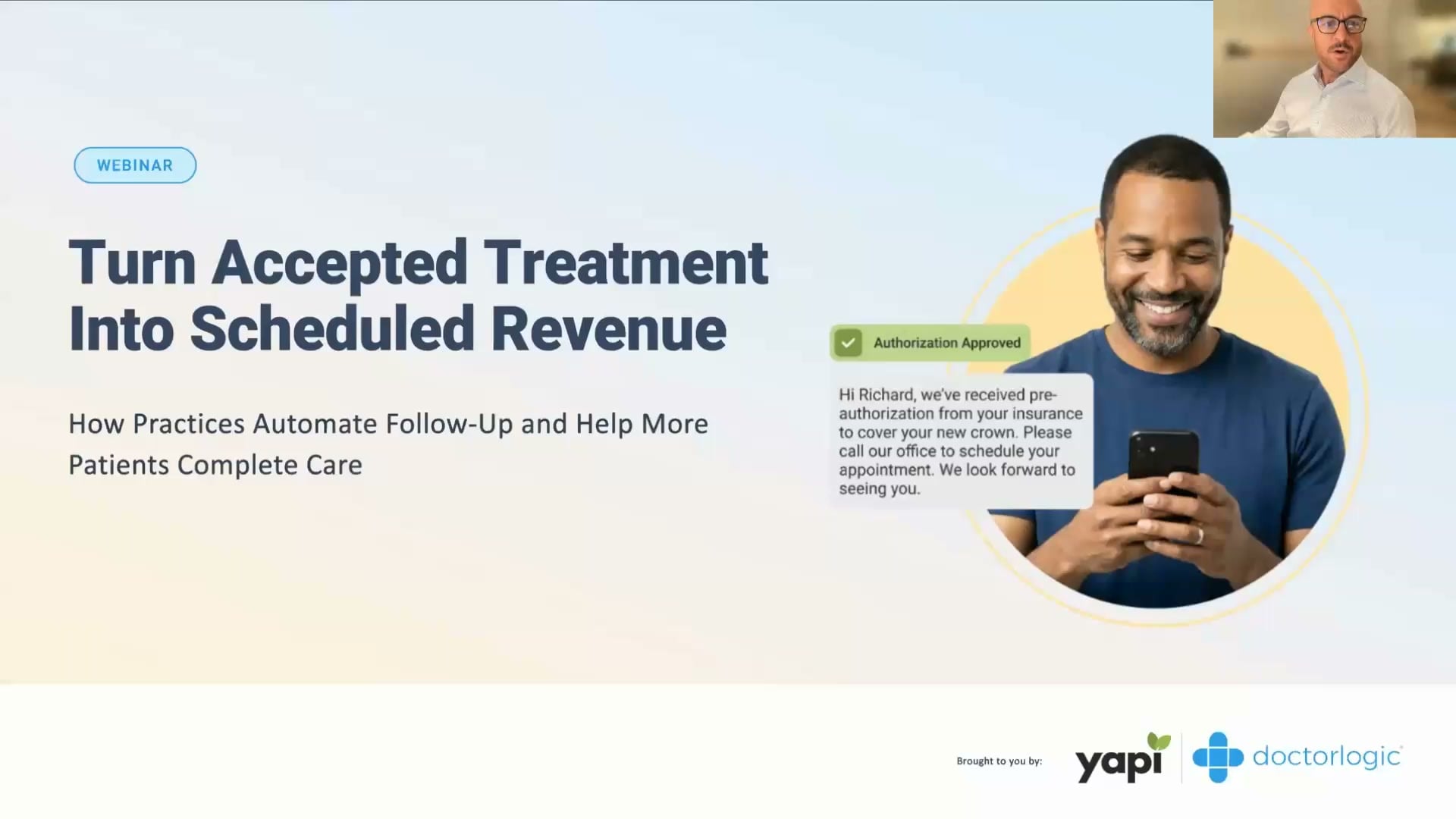
If you want a deeper walkthrough of a patient centered follow up system, watch the recorded webinar, Close the Loop: Keep Patients on Track and Schedules Full.
You will learn:
- How to build consistent recall and treatment plan follow up workflows
- How to reduce gaps in care without adding manual workload
- How to improve patient responsiveness through timing, relevance, and channel choice
Want help applying this to your practice?
If you would like a second set of eyes on your recall and treatment follow up workflow, a Yapi solutions consultant can review your current process and share practical recommendations based on what high performing teams do today.